Showing posts with label Water Spot. Show all posts

Monday, November 2, 2009

Victoria Falls


The Victoria Falls or Mosi-oa-Tunya (the Mist that Thunders) is a waterfall located in southern Africa on the Zambezi River between the countries of Zambia and Zimbabwe. The falls are some of the largest in the world . . .


Victoria falls is one of the Seven Natural Wonders of the World.  David Livingstone, the Scottish explorer, is believed to have been the first European to view the Victoria Falls, and this is the name in use in Zimbabwe. The older, indigenous name of Mosi-oa-Tunya is the name in official use in Zambia. The World Heritage List recognises both names.  While it is neither the highest nor the widest waterfall in the world, it is claimed to be the largest. This claim is based on a width of 1,708 metres (5,600 ft) and height of 108 meters (360 ft), forming the largest sheet of falling water in the world. The falls' maximum flow rate compares well with that of other major waterfalls.


Victoria Falls town (in Zimbabwe) lies on the southern bank of the Zambezi River at the eastern end of the Victoria Falls themselves. Victoria Falls Airport is 18 km south of the town and has international services to Johannesburg and Namibia.


Livingstone (in Zambia) is a historic colonial city and tourism centre for Victoria Falls lying 10 km south on the Zambezi River, and a border town with road and rail connections to Zimbabwe on the other side of the Falls. The Airport has connections to Lusaka and Johannesburg in South Africa.


The river's annual flood season is February to May with a peak in April. The spray from the falls typically rises to a height of over 400 metres (1,300 ft), and sometimes even twice as high, and is visible from up to 50 km (30 miles) away.


During the flood season, however, it is impossible to see the foot of the falls and most of its face, and the walks along the cliff opposite it are in a constant shower and shrouded in mist. Close to the edge of the cliff, spray shoots upward like inverted rain, especially at Zambia's Knife-Edge Bridge.


As the dry season takes effect, the islets on the crest become wider and more numerous, and in September to January up to half of the rocky face of the falls may become dry and the bottom of the First Gorge can be seen along most of its length.


The most popular location is known as the “Devil’s Swimming Pool” where during the months of September and December, visitors can swim as close as possible to the edge of the falls without falling over. Pretty cool isn’t it? Below are the brave and splendid photos of people who have visited the scariest pool.


The Victoria Falls Bridge over Zambezi River connecting Zimbabwe and Zambia is reckoned a perfect spot by bungee jumpers to get a close brush of the spraying falls. Once you jump off, the fall may seem to rush up to you at a maddening pace but you can trust the ankle and body harnesses for their full-proof security.


Friday, October 30, 2009

Venice


Venice is a city in northern Italy, the capital of the region Veneto. Together with Padua, the city is included in the Padua-Venice Metropolitan Area . . .

The city historically was an independent nation. Venice has been known as the "La Dominante", "Serenissima", "Queen of the Adriatic", "City of Water", "City of Bridges", and "The City of Light" . . .


Venice is built on one hundred and seventeen small islands, and holds one hundred and fifty canals, connected by an amazing four hundred and nine bridges, of which only three cross the main canal. The area it covers is a mere 284 miles (458 kilometres). Although the city appears small, it is really quite extensive for its size with a fair number of Venice restaurants and Venice hotels (off peak) to choose from. While most tour guides don’t recommend getting lost in the majority of cities during your Venice vacation, Venice is the place to get hopelessly lost for a day. However, Venice isn’t all cities and crowded streets. Through the mysterious alleyways leading off from the city, endless mazes of backstreets and deserted squares, on your Venice trip, you’ll find that this city is a perfect place to walk for hours on end, pretending to know where you are.


The city stretches across 118 small islands in the marshy Venetian Lagoon along the Adriatic Sea in northeast Italy. The saltwater lagoon stretches along the shoreline between the mouths of the Po (south) and the Piave (north) Rivers. The population estimate of 272,000 inhabitants includes the population of the whole Comune of Venezia; around 62,000 in the historic city of Venice (Centro storico); 176,000 in Terraferma (the Mainland), mostly in the large frazione of Mestre and Marghera; and 31,000 live on other islands in the lagoon.


The Republic of Venice was a major maritime power during the Middle Ages and Renaissance, and a staging area for the Crusades and the Battle of Lepanto, as well as a very important center of commerce (especially silk, grain and spice trade) and art in the 13th century up to the end of the 17th century. Venice is also famous for its musical, particularly operatic, history, and its most famous son in this field is Antonio Vivaldi.


Venice is world-famous for its canals. It is built on an archipelago of 118 islands formed by 177 canals in a shallow lagoon. The islands on which the city is built are connected by about 400 bridges. In the old center, the canals serve the function of roads, and every form of transport is on water or on foot. In the 19th century a causeway to the mainland brought a railway station to Venice, and an automobile causeway and parking lot was added in the 20th century. Beyond these land entrances at the northern edge of the city, transportation within the city remains, as it was in centuries past, entirely on water or on foot. Venice is Europe's largest urban car free area, unique in Europe in remaining a sizable functioning city in the 21st century entirely without motorcars or trucks.


The classical Venetian boat is the gondola, although it is now mostly used for tourists, or for weddings, funerals, or other ceremonies. Most Venetians now travel by motorised waterbuses (vaporetti) which ply regular routes along the major canals and between the city's islands. Many gondolas are lushly appointed with crushed velvet seats and Persian rugs. Gondoliers typically charge between 80 and 100 euros for a 35 minute "giro" or excursion around some canals. The city also has many private boats. The only gondolas still in common use by Venetians are the traghetti, foot passenger ferries crossing the Grand Canal at certain points without bridges. Visitors can also take the watertaxis between areas of the city.


Sunday, October 25, 2009

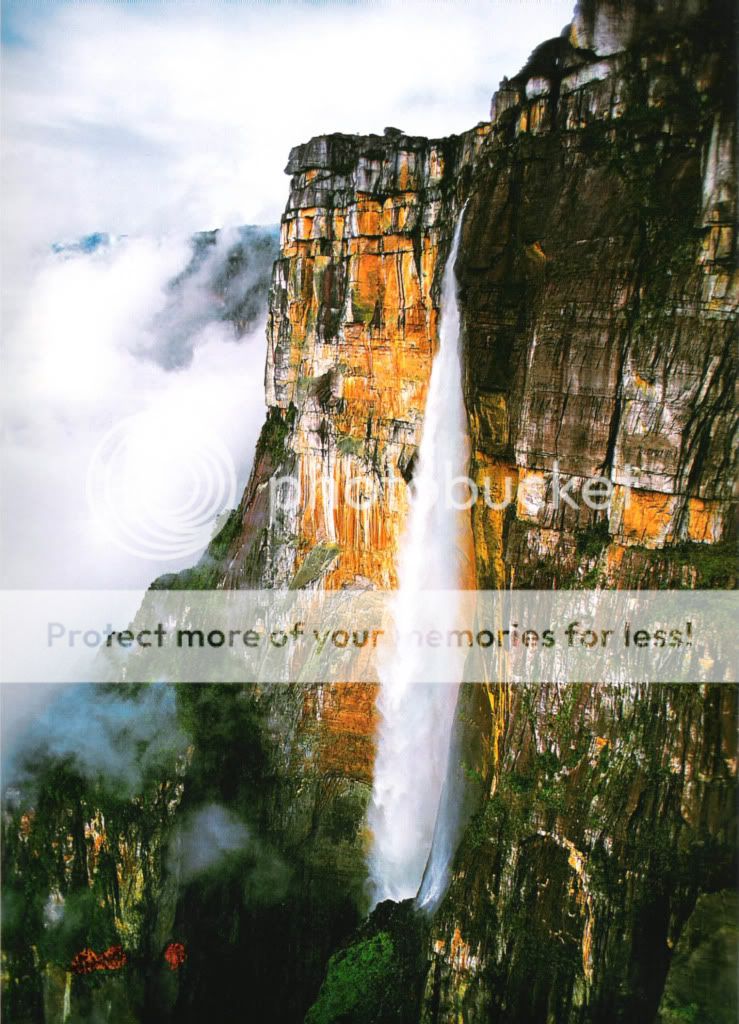
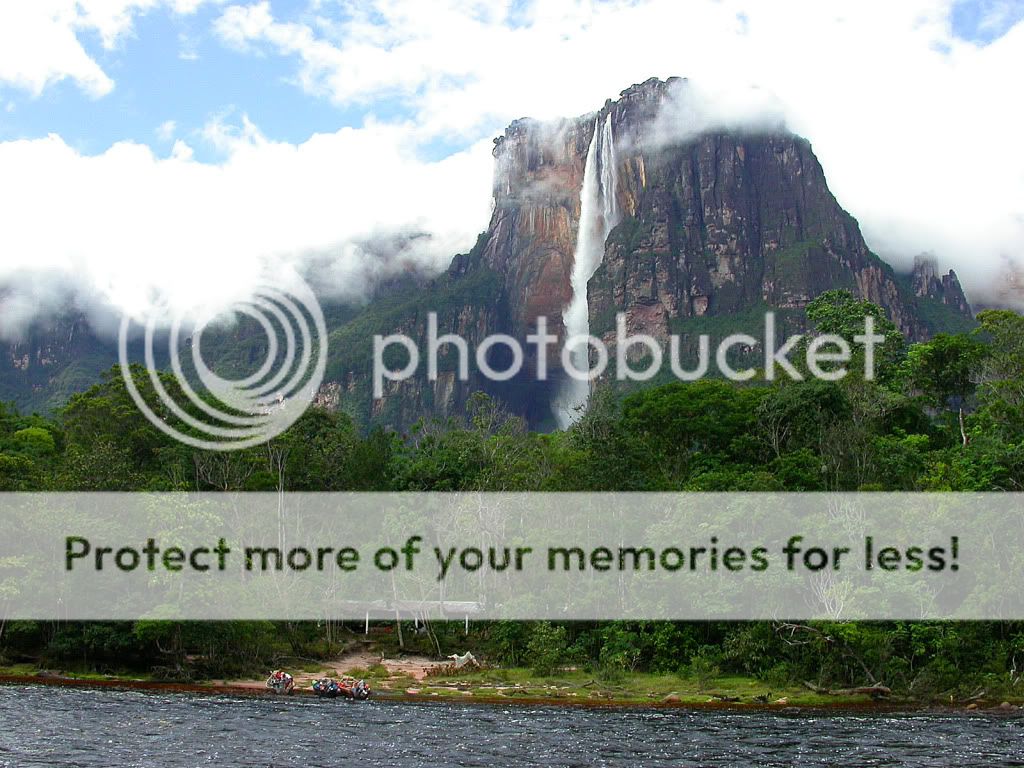
Angel Falls the highest waterfall in the world


Angel Falls is the highest waterfall in the world with a 979 meter tall.  This waterfall located in Canaima National Park, in the territory of Gran Sabana, Bolivar State, Venezuela.   No one seems to know what the stream the falls occur on is called.


For the longest time, there have been references to Angel Falls being known in Pemon (the local language) as Churún Merú, and the falls subsequently being on Rio Churún. However, the real Pemon name of the falls is Kerepakupai Merú, which means "fall from the deepest place". To further clear this issue, Churún Merú is a totally different waterfall of about half the height of Angel Falls, located further up the large canyon bysecting Auyan Tepui.


The waters above the falls drop into a series of cracks, crevices, and gorges and burst out of the cliff face about 50 feet below the brink. The waterfall segments in periods of highest water. We've seen photos that show the falls split into 3 major portions, creating a veil of water on the order of 600' in width.


Pilot Jimmy Angel is widely credited for discovering the falls in 1937, but the true discoverer was one Ernesto de Santa Cruz, who found the falls in 1910. The falls were subsequently named for Jimmy Angel, since he was the first westerner to view the falls.


Angel Falls is one of Venezuela's top tourist attractions, but even today a trip to the falls is not a simple affair. The falls are located in an isolated jungle region of Venezuela, and a flight from Caracas or Ciudad Bolívar is required to reach Canaima camp, the starting point for river trips to the base of the falls.


It is also possible to purchase a package that includes an aerial flyby of the falls. The falls cannot be seen on cloudy days, and there is no guarantee visitors will see them.


River trips generally take place from June to December, when the rivers are deep enough for the wooden curiaras used by the Pemon Indian guides. During the dry season (December to March) there is less water than is seen in some photos, but it is also more likely that the top will not be clouded.


Monday, October 19, 2009

Dean's Blue Hole the deepest blue hole in the world


Dean's Blue Hole is the world's deepest blue hole (underwater sinkhole), which plunges 202 metres (663 ft) to the ocean floor, in a bay west of Clarence Town on Long Island, Bahamas . . .


In April 2007, William Trubridge broke a free-diving world record in the blue hole reaching a depth of 84 metres (276 ft) without the use of fins. In April 2008, during the Vertical Blue 2008 free-diving competition, a total of 25 national records and 5 world records were broken. During this event, William Trubridge broke his own world record in the Constant Weight Without Fins (CNF) category reaching 86 metres (282 ft) as well as breaking the record in Free Immersion (FIM) at 108 metres (354 ft). In April 2009, Australian Walter Steyn achieved a new Australian free-diving record of 100 metres (330 ft) at Dean's Blue Hole.


Blue holes are the results of rainwater having soaked through fractures of limestone bedrock onto the watertable of glacial sea levels during the Pleistocene epoch (ice age), some 15,000 years ago. The maximum depth of other known blue holes and sinkholes is 110 metres (360 ft), which makes the 202 metres (663 ft) depth of Dean's Blue Hole quite exceptional.


Dean's Blue Hole is roughly circular at the surface, with a diameter ranging from 25 to 35 metres (82–110 ft). After descending 20 metres (66 ft), the hole widens considerably into a cavern with a diameter of 100 metres (330 ft).


Nemo33 The deepest swimming pool in the world


This swimming pool is in Nemo33 in Brussels, Belgium. This pool contains 2.5 million liters of water (660.430 gallons) and there are many alleys in there built like caves in the sea . . .
This pond has a depth of 33 meters with water temperatures warm, or 33 Celsius ... it's very fun!


Oh yeah... You can also find swimming lessons here that will help you to learn to dive.
Have fun with this cool site !!!